


Getting more customers is not the only way to grow a Shopify store. You can also increase revenue by helping existing customers discover useful products before and after they complete a purchase.
Two strategies commonly used for this purpose are Shopify cross sell offers and post-purchase upsells.
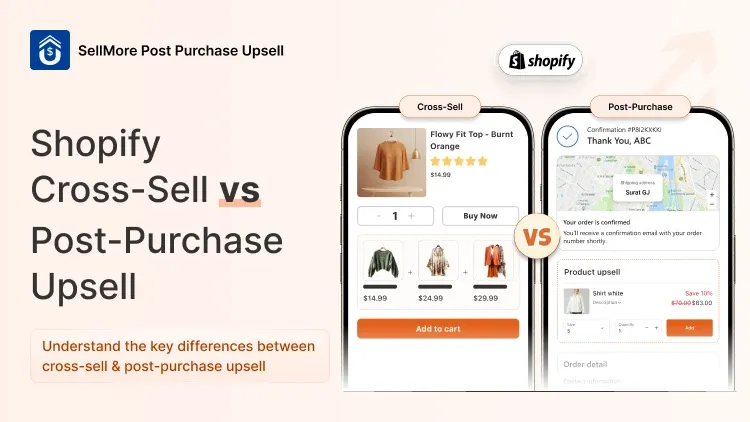
A cross-sell recommends a complementary product while the customer is still shopping. A post-purchase upsell appears after the customer has completed payment and gives them another opportunity to add to their order.
Both strategies can increase average order value, but they work at different stages of the buying journey.
This guide explains nine important differences between Shopify cross-selling and post-purchase upselling. It also shows how merchants can use both strategies together and how SellMore helps create targeted offers across checkout, post-purchase, thank-you, and order-status pages.
Shopify Cross-Sell vs Post-Purchase Upsell: The Main Difference
The main difference is when the offer appears.
A Shopify cross sell offer usually appears before the customer completes payment. It recommends a product that complements an item the customer is viewing or has already added to the cart.
A Shopify post purchase upsell appears after the payment has been completed. It gives the customer a chance to add another product without affecting the original purchase.
Shopify explains that customers can decline a post-purchase offer without changing their completed order. When they accept the offer, the original order is updated to include the additional product.
Here is a simple example:
- Cross-sell: Recommend a phone case when a customer adds a phone to the cart.
- Post-purchase upsell: Offer a discounted wireless charger after the customer pays for the phone.
The two strategies are not direct replacements for each other. They solve different problems and often work best when used together.
9 Differences Between Shopify Cross-Sell and Post-Purchase Upsell
Understanding the following differences will help you decide where each offer belongs in your sales journey.
1. The Offers Appear at Different Times
Timing is the clearest difference between Shopify cross-selling and post-purchase upselling.
A Shopify cross sell offer appears before the transaction is complete. Depending on your store setup, it may appear on the:
- Product page
- Add-to-cart popup
- Cart drawer
- Full cart page
- Checkout page
At this stage, the customer is still deciding whether to complete the original purchase.
A post-purchase upsell appears after payment. Shopify describes this page as the stage after customers complete payment but before they reach the order confirmation page.
This timing changes how customers react to the offer.
Before payment, they may be carefully reviewing the total cost. After payment, they may feel more confident because their main shopping decision has already been made.
2. Cross-Selling Can Affect the Original Conversion
A badly placed cross-sell can interrupt the buying process.
For example, imagine that a customer adds a $60 product to the cart. Instead of showing one useful accessory, the store displays eight unrelated recommendations, two popups, a bundle offer, and a countdown timer.
The customer now has more decisions to make. They may reconsider the purchase or leave the store.
This does not mean Shopify cross sell offers are harmful. It means they must be:
- Relevant
- Easy to understand
- Simple to accept or ignore
- Visually separate from the checkout button
- Appropriate for the customer’s cart
A Shopify post purchase upsell carries less risk for the initial conversion because the customer has already completed payment.
Shopify confirms that declining a post-purchase offer does not affect the completed purchase.
For merchants worried about disrupting checkout, post-purchase offers provide a safer place to test additional recommendations.
3. The Customer Has a Different Mindset
Customer intent changes throughout the buying process.
During a cross-sell offer, the shopper is still evaluating:
- The product
- The total order value
- Shipping charges
- Available discounts
- Delivery expectations
- Whether to complete checkout
The cross-sell must therefore support the original purchase rather than distract from it.
After payment, the customer’s main decision is complete. They have already selected the product, entered their details, chosen a payment method, and placed the order.
This creates a different opportunity.
A Shopify post purchase upsell can use the customer’s completed purchase to recommend a highly specific next product.
For example:
- After buying running shoes, offer performance socks.
- After buying a coffee machine, offer a pack of coffee beans.
- After buying a camera, offer a memory card.
- After buying pet food, offer treats or supplements.
- After buying a dress, offer a matching accessory.
The post-purchase offer should feel like a useful continuation of the purchase, not an unrelated promotion.
4. The Two Strategies Have Different Goals
The main goal of a Shopify cross sell offer is to make the current cart more complete.
It helps customers discover products they may need alongside the original item.
The main goal of a post-purchase upsell is to create additional revenue after the original sale has been secured.
Consider a merchant selling electric toothbrushes.
A cross-sell could recommend:
- Toothpaste
- Dental floss
- A travel case
A post-purchase upsell could offer:
- A multi-pack of replacement brush heads
- An upgraded travel kit
- A discounted second toothbrush
The cross-sell improves the current shopping experience. The post-purchase offer creates another revenue opportunity from the completed transaction.
Both strategies can increase average order value, but they reach that goal through different customer moments.
5. Different Products Work Better for Each Offer
Not every product belongs in every offer location.
The best Shopify cross sell products are usually low-friction items that clearly match what is already in the cart.
- Good cross-sell products are often:
- Lower-priced than the main product
- Easy to understand
- Frequently purchased with the original product
- Useful immediately
- Available without complicated options
For example, showing a $15 phone case with a $500 phone is easy to understand.
A post-purchase upsell can support a wider range of offers because the initial sale has already been completed.
It may include:
- A premium upgrade
- A larger pack
- A second related product
- A discounted bundle
- A refill
- A subscription
- A complementary product at a special price
However, the offer must still be relevant. Completing the payment does not make customers interested in random products.
Use order history, product relationships, and customer behavior to decide which products belong together.
6. Post-Purchase Offers Can Create Less Buying Friction
A pre-purchase cross-sell adds another decision before checkout.
The customer must decide whether to add the item, review the updated cart, and continue toward payment.
This can work well when the offer is simple. However, products with several sizes, colors, models, or technical options may slow the customer down.
A post-purchase offer can make the additional purchase easier because the customer’s main payment has already been completed.
Compatible Shopify post-purchase apps can allow customers to accept an offer without restarting the entire checkout process. Shopify’s App Store also has a dedicated collection for apps that provide one-click post-purchase offers.
This makes post-purchase placement useful for impulse-friendly products and simple add-ons.
The offer should still display important information clearly, including:
- Product name
- Product image
- Price
- Discount, when applicable
- Quantity
- Main benefit
- Accept and decline options
Reducing steps should never mean hiding important purchase information.
7. Offer Placement Options Are Different
A Shopify cross sell strategy can cover several areas of the online store.
Common cross-sell placements
- Below the main product information
- Near the add-to-cart button
- Inside a cart popup
- Inside the cart drawer
- On the full cart page
- Within checkout, where supported
Earlier placements give customers more time to review the recommendation. Cart and checkout placements reach customers with stronger purchase intent.
Common post-purchase placements
- Checkout post-purchase page
- Thank-you page
- Order confirmation page
- Order-status page
- Post-purchase email
Shopify supports adding app-based features such as upsell offers to the post-purchase stage of checkout.
Each page has a different purpose.
The immediate post-purchase page is useful for a direct add-on offer. The thank-you and order-status pages can continue showing product recommendations, announcements, or offers after the transaction.
Instead of repeating the same product everywhere, create a connected sequence.
8. The Offer Messages Should Be Different
A cross-sell message should explain how the recommended product supports the item already selected.
Examples include:
- Complete your setup
- Frequently purchased together
- Add a matching accessory
- Protect your new device
- Customers also add
- Do not forget these essentials
The message should focus on usefulness and convenience.
A Shopify post purchase upsell message can build on the excitement of the completed order.
Examples include:
- Add this to your order
- Complete your routine
- Get more from your purchase
- Add a matching product
- Special offer for your order
- One more item you may need
Some post-purchase offers also use discounts or countdown timers. These can create urgency, but the offer should not use false scarcity or misleading deadlines.
A clear, relevant message will usually be more effective than aggressive sales copy.
9. You Measure Their Performance Differently
Both strategies should be measured, but the performance reports are not identical.
Shopify cross sell metrics
Track:
- Cross-sell views
- Add-to-cart rate
- Offer acceptance rate
- Average order value
- Conversion rate
- Revenue generated by the cross-sell
- Cart abandonment rate
- Profit per order
Pay particular attention to conversion rate.
A cross-sell may increase cart value while lowering the percentage of customers who complete checkout. In that situation, the offer may be creating too much friction.
Shopify post purchase upsell metrics
Track:
- Post-purchase offer views
- Offer acceptance rate
- Additional revenue
- Average post-purchase value
- Revenue per offer
- Product-level performance
- Funnel performance
- Discount cost
- Gross profit
Shopify’s analytics documentation includes data for measuring the reach and use of post-purchase offers in supported Shopify experiences.
The strongest offer is not always the one that generates the most gross revenue. Check whether discounts, product costs, payment expenses, shipping costs, and fulfillment requirements still make it profitable.
How to Use Cross-Sells and Post-Purchase Upsells Together
A connected funnel is more effective than repeating the same recommendation across every page.
Follow these steps to build one.
Step 1: Review Products Commonly Purchased Together
Use order data to find products customers already purchase in the same order.
Look for clear relationships such as:
- Main product and accessory
- Starter product and refill
- Clothing item and matching accessory
- Device and protection product
- Food product and serving tool
These relationships provide a stronger starting point than random recommendations.
Step 2: Choose the Pre-Purchase Cross-Sell
Select one product that helps customers complete their current purchase.
Keep the offer simple and avoid overwhelming the cart with several alternatives.
Step 3: Choose a Different Post-Purchase Offer
The post-purchase product should add value without repeating the same rejected cross-sell.
For example:
- Cross-sell a phone case before checkout.
- Post-purchase upsell a wireless charger after payment.
This gives the customer two different but relevant opportunities.
Step 4: Create Rules for Different Orders
Do not show the same offer to every customer.
Your offers can be based on:
- Purchased product
- Product collection
- Cart value
- Customer type
- Order quantity
- Previous purchase
- Specific product combinations
Targeted offers usually feel more useful than storewide recommendations.
Step 5: Test One Change at a Time
Start with one funnel and record your existing average order value.
Then monitor:
- Offer views
- Acceptance rate
- Added revenue
- Conversion rate
- Profit
- Product performance
Test the product, discount, message, and placement separately. Changing everything at once makes it difficult to identify what produced the result.
Use SellMore to Build Post-Purchase Upsell Funnels
Creating personalized offers across checkout, post-purchase, thank-you, and order-status pages can be difficult to manage manually.
SellMore Post Purchase Upsell is designed to help Shopify merchants create targeted upsell and cross-sell funnels across these stages.
SellMore supports:
- One-click post-purchase upsells
- Checkout upsells and cross-sells
- AI-powered product recommendations
- Product bundles
- Multiple-product post-purchase offers
- Thank-you-page offers
- Order-status-page offers
- Discount countdown timers
- Promotional banners
- Funnel analytics
These features allow merchants to show different recommendations based on where the customer is in the purchasing journey.
Conclusion
Shopify cross-selling and post-purchase upselling both help merchants generate more revenue from customers who are already interested in their products.
The key difference is timing.
A Shopify cross sell offer helps customers add complementary products before payment. A Shopify post purchase upsell creates another sales opportunity after the original transaction is complete.
Cross-selling is useful for completing the cart, while post-purchase upselling can increase order value without placing the initial purchase at risk.
For the strongest strategy, use both.
Show a simple and relevant cross-sell while customers are shopping. After payment, present a different offer that naturally supports the completed purchase.
SellMore helps Shopify merchants create these offers across checkout, post-purchase, thank-you, and order-status pages. With targeted funnels, AI recommendations, bundles, multiple-product offers, and analytics, merchants can continue growing revenue even after the customer clicks the payment button.